PDF Is 30 Years Old and Nothing Has Managed to Kill It — Here's Why
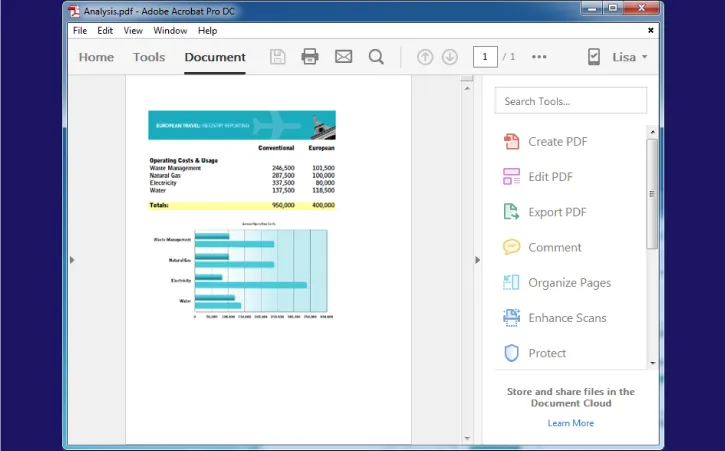
Photo: PDF document files on computer screen office professional, via helpx.adobe.com
In 1993, Adobe released a file format called the Portable Document Format. Bill Clinton had just been inaugurated. The World Wide Web was barely a year old. Jurassic Park was in theaters.
Thirty-plus years later, every Explanation of Benefits from your health insurer, every mortgage disclosure from your lender, every tax form from the IRS, and every closing statement from your real estate attorney arrives as a PDF. Not a Word doc. Not a Google Doc. Not some sleek new format built for the modern web.
A PDF.
This is not an accident. It's not inertia. It's not laziness — well, not entirely. There are real, structural reasons why the most sensitive documents in American life are locked inside a format that predates most of the internet as we know it. Let's get into it.
What Makes a PDF Different From Everything Else
To understand why PDF won, you have to understand what it actually is — because most people don't.
A PDF is not a document in the way a Word file is a document. A Word file is a set of instructions: "use this font, this size, this margin, arrange these words in this order." The final appearance depends on your version of Word, your operating system, your installed fonts, and a dozen other variables. Open the same .docx on two different computers and you might get two subtly different results.
A PDF is closer to a photograph of a document. It captures not just the content, but the exact visual appearance — every character precisely positioned, every font embedded, every image locked in place. Open a PDF on a 2008 MacBook or a 2024 Windows 11 machine or an Android phone and you get the exact same thing. That's the "portable" in Portable Document Format, and it's not a small deal.
For industries where a document's precise appearance is legally significant — think mortgage disclosures, medical records, court filings — this property is everything.
Why Banks and Lenders Specifically Can't Quit It
The financial industry's relationship with PDF isn't just about aesthetics. It's about compliance.
Federal regulations like the Truth in Lending Act and the Real Estate Settlement Procedures Act require that certain disclosures be presented to consumers in specific, standardized formats. When a lender sends you a Loan Estimate or a Closing Disclosure, there are federal rules about what information appears where, in what order, in what relative size. A PDF guarantees that document looks identical to every other version of that document, on every device, for every borrower.
There's also the audit trail question. Financial institutions keep records for years — sometimes decades. A PDF from 2010 will open correctly in 2035. The same cannot be said with confidence for proprietary formats tied to software that might not exist anymore. PDF is an open ISO standard (has been since 2008), which means it's not controlled by any single company and won't disappear if Adobe goes under.
Healthcare's Paper Problem — Solved by PDF
Hospitals and medical practices in the US deal with a documentation nightmare that would make most industries weep. They're juggling HIPAA requirements, insurance billing codes, referral letters, lab results, consent forms, and discharge instructions — often across multiple incompatible electronic health record systems.
PDF became the lingua franca of healthcare documentation precisely because it doesn't care what system generated it. A lab report exported from Epic looks the same as one exported from Cerner when both land in your patient portal as a PDF. A consent form scanned at a clinic in rural Montana and a digitally generated one from a hospital in Manhattan can both be stored, transmitted, and archived the same way.
The format also supports digital signatures — legally binding ones — which made the transition from paper to electronic records far smoother than it would have been otherwise.
The Legal Industry's Iron Grip
If you want to understand why PDF is truly unshakeable, look at courts.
Federal courts across the US require documents to be filed in PDF format. Many state courts do too. The federal judiciary's CM/ECF system — the electronic filing platform used by every federal district court — runs on PDF. Attorneys file briefs, motions, and exhibits as PDFs. Judges issue opinions as PDFs. Appellate records are compiled as PDFs.
This isn't just convention. Courts need documents that can be stored in archives for decades, that look identical to every party in a case regardless of their technology setup, that can be searched and annotated without altering the underlying record. PDF does all of that.
Once a format becomes embedded in the legal system at the federal level, you're not replacing it with a trend.
So Why Can't Something Better Come Along?
It's a fair question. PDF has real limitations. Large PDFs can be clunky to navigate. Accessibility for screen readers has historically been inconsistent (though PDF/UA standards have improved this). Editing a PDF without dedicated software is a pain. Web-native formats like HTML5 are more flexible and more accessible by default.
So why hasn't something better taken over?
The answer is a concept sometimes called "institutional lock-in" — and in the case of PDF, it runs deeper than most formats have ever achieved. It's not just that people are used to PDF. It's that:
- Regulations are written around it. Changing the format would require rewriting federal and state rules.
- Software ecosystems are built on it. Document management systems, e-signature platforms, court filing systems, and healthcare record systems all treat PDF as the ground truth.
- Training and workflows assume it. Every paralegal, loan officer, and medical records coordinator in America knows how to handle a PDF.
- It's an open standard. There's no licensing fee, no single vendor to negotiate with, no proprietary lock.
A challenger format would need to be dramatically better — not incrementally better — to justify the cost and disruption of switching. And it would need every industry to switch simultaneously, because the whole value of a universal format is that it's universal.
What Would Actually Replace It?
Honestly? Nothing is close. There are niche challengers — EPUB for publishing, various XML-based formats for structured data — but none of them do what PDF does for the specific use case of "here is a finalized document that needs to look identical everywhere and be preserved forever."
The most likely long-term scenario isn't replacement. It's evolution. PDF already has specialized variants: PDF/A for archiving, PDF/X for printing, PDF/E for engineering documents. Future versions of the standard will keep getting better at accessibility, interactivity, and digital signature verification.
PDF isn't going to die. It's going to keep quietly running the most important paperwork in your life — just like it has been since before most of its current users were born.